
Sildenafil, tadalafil, vardenafil and avanafil compared
Compare the four oral ED ingredients by brand, prescribing context and label-specific differences.
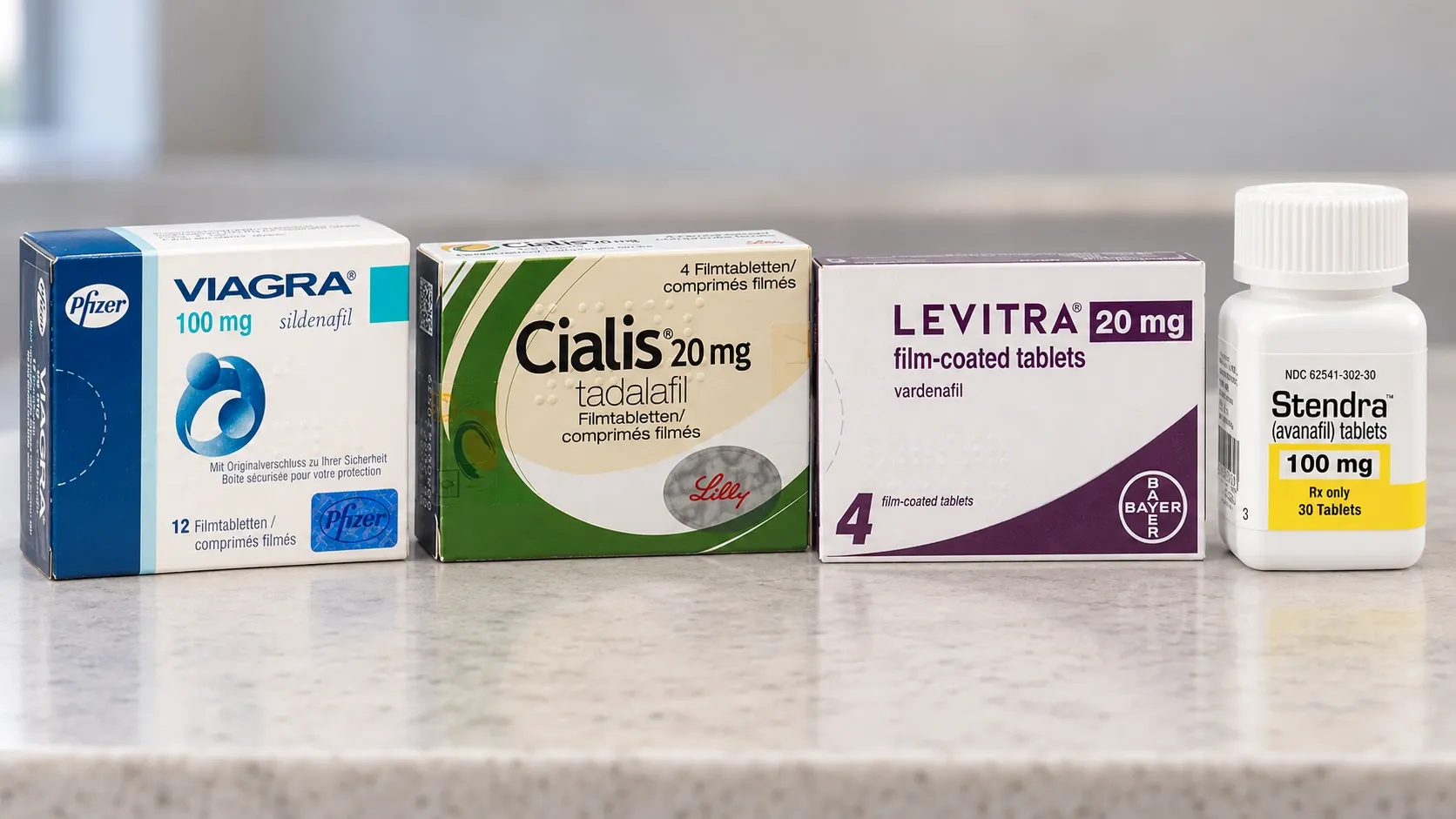
AI-generated editorial illustration based on example packaging. Packs may differ by market; the image does not verify authenticity.
Sildenafil, tadalafil, vardenafil and avanafil all support an erection response through PDE5 inhibition. The most useful comparison is how a treatment fits the person’s routine, other medicines and response—not which pack advertises the largest number or earliest onset.
Four practical distinctions
| Ingredient | A useful difference | What needs context |
|---|---|---|
| Sildenafil | Familiar shorter-window option; ordinary-tablet food and timing can matter | An unsuccessful first attempt may reflect how it was used, not complete treatment failure |
| Tadalafil | Longer response window and separate daily/as-needed approaches | Longer exposure also extends interaction considerations; a window is not a continuous erection |
| Vardenafil | Documented differences between film-coated and orodispersible forms | Same-number formulations are not automatically equivalent; QT precautions need a medicine/history review |
| Avanafil | Randomized evidence for successful early attempts | Fifteen-minute results are group attempt measures, with strength-specific label instructions |
Product examples include Viagra, Cialis, Levitra and the regional avanafil brands Stendra and Spedra. The illustration uses example packaging; the product records identify the actual markets and presentations reviewed.
Onset, window and half-life answer different questions
Onset concerns when benefit can begin under specified conditions. A response window concerns the period over which stimulation may produce benefit. Half-life describes falling blood concentrations. None is the duration of one erection, and they should not be substituted for one another in a comparison chart.
The rapid-onset avanafil trial illustrates the distinction. It measured each participant’s proportion of attempts with early penetration and successful intercourse. It found an advantage over placebo, but did not guarantee a result for every participant or compare all four ingredients directly.
Food and formulation can change an apparent result
The ordinary sildenafil film-coated and vardenafil film-coated reference information describes meal-related timing effects. Tadalafil’s reference information says food does not change its absorption rate or extent. Those distinctions belong to the identified formulations; they should not be transferred to every jelly, sublingual claim or combination tablet.
Vardenafil’s orodispersible formulation gives a particularly clear warning against choosing by milligrams alone: its exposure differs from the same-number film-coated tablet. Read the formulation guide before interpreting “Professional” as a proven clinical advantage.
The choice includes tolerability and follow-up
Headache or another unwanted effect may matter more to an individual than the advertised window. Cardiovascular suitability, nitrates, metabolic interactions and other ED treatments also influence the prescribing discussion. The interaction overview covers the shared precautions and important differences.
If treatment disappoints, explain the exact medicine, amount, form, timing, meal and response. The troubleshooting guide shows why that review is more useful than unsupervised dose changes or combining products to conduct a personal comparison.
Sources
8 sources
Checked .
- Viagra product information — European Medicines Agency
- Cialis product information — European Medicines Agency
- Levitra product information — European Medicines Agency
- Spedra product information — European Medicines Agency
- Stendra prescribing information — DailyMed, US National Library of Medicine
- viagra uk label
- Pharmacokinetics of a new orodispersible tablet formulation of vardenafil: results of three clinical trials.
- Efficacy of Avanafil 15 Minutes after Dosing in Men with Erectile Dysfunction: A Randomized, Double-Blind, Placebo Controlled Study.