
Mirodenafil: ingredient and products
What mirodenafil film research shows, its mixed endpoints and why a dissolving form does not prove faster action than a tablet.
Mirodenafil is a PDE5 inhibitor developed in South Korea. Its orally dissolving film research offers a useful example of how a convenient formulation can be supported by a trial without proving that it acts faster than an ordinary tablet.
Key points
- A film’s convenience and its clinical speed are separate questions.
- The main film study compared treatment with placebo, not with an ordinary mirodenafil tablet.
- Only the 100 mg group separated significantly from placebo on its primary questionnaire outcome.
- A nonsignificant result at 50 mg is not proof that no patient benefited.
- Historical development, current marketing and today’s product authorization require different evidence.
What the film trial measured
A multicentre randomized study assigned 129 Korean men with ED to placebo or mirodenafil orally dispersible film at 50 or 100 mg, used on demand for eight weeks. The primary outcome was the IIEF-5 erectile-function questionnaire, with sexual-encounter and satisfaction measures as secondary outcomes.
Questionnaire scores increased in all three groups. Only the 100 mg film group showed a statistically significant primary-outcome difference from placebo. Some secondary measures improved, but the penetration-success measure did not show a statistically significant increase. The full report is useful because it makes the mixed endpoint results visible rather than reducing the study to “effective.”
The lower-strength result means the trial did not establish a clear difference on that endpoint under its conditions. It does not prove zero effect in every participant. Conversely, the positive higher-strength result does not establish that more is always better or that the film beats a conventional tablet. The short follow-up and selected Korean population also limit broader conclusions.
What dissolving changes—and what remains unknown
A film can remove the need to swallow a conventional solid tablet and can be more convenient for some users. This study did not directly compare onset with a swallowed tablet. A claim of superior speed would need a suitable head-to-head clinical or pharmacokinetic comparison for the exact formulations.
The paper’s discussion cites rapid absorption and an approximately 2.5-hour half-life from other research. Published estimates vary with the study and formulation. This profile therefore does not present one half-life as a guaranteed period of benefit. Reaching peak blood concentration is also different from the earliest successful sexual attempt.
Tolerability and evidence coverage
Most treatment-associated adverse events in the film trial were mild and resolved spontaneously. Flushing and headache were among the reported problems. A study of 129 men over eight weeks cannot establish that a medicine has no uncommon or long-term risks.
The trial and earlier development records do not substitute for a current local product leaflet covering contraindications, interacting medicines and the supplied form. As with other PDE5 treatments, the review must include nitrates, other ED products and cardiovascular suitability. “Dissolves without water” is a convenience description, not a safety advantage established by this trial.
The Mvix connection
Mvix is the product family connected with mirodenafil and historical SK Chemicals development. Tablet and film names should remain distinct. This directory has not independently confirmed a current Korean authorization holder for every presentation, so the historical developer is labelled as such rather than promoted into an unverified current role.
Products containing mirodenafil
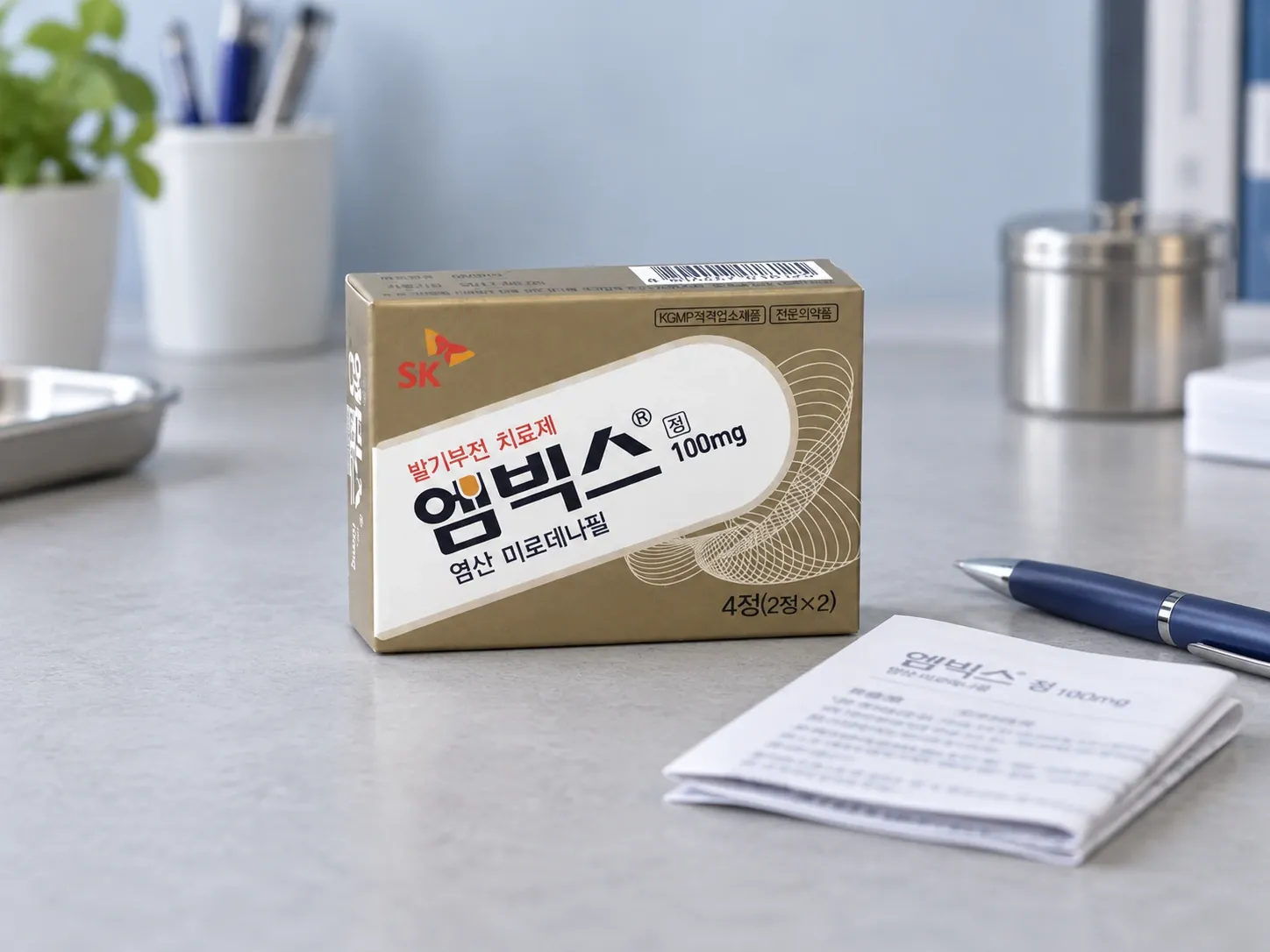 Mirodenafil
Mvix (mirodenafil)
Mvix and mirodenafil: historical Korean development, tablet versus film evidence and the limits of current product identification.
Sources
2 sources
Checked .
- Mirodenafil orally dispersible film trial — World Journal of Men’s Health
- Film trial full text — Europe PMC